Bhutan is often associated with its beautiful monasteries, colourful festivals, snow-covered Himalayan mountains, and peaceful valleys. But there is another side of the Kingdom that nature lovers find equally fascinating: its extraordinary wildlife and birdlife.
For a relatively small country, Bhutan has an impressive variety of natural habitats. From subtropical forests in the south to temperate woodlands, alpine meadows, high mountain passes, and glacial valleys in the north, the landscape changes dramatically as you travel across the country. Each region supports different species of birds, mammals, and other wildlife.
For travelers interested in nature, this makes Bhutan a particularly rewarding destination.
You might spot a Himalayan monal moving through a forest, watch black-necked cranes feeding in a quiet valley, hear the distinctive calls of hornbills in the subtropical forests, or, with a little luck, catch a glimpse of a red panda in its natural habitat.
Bhutan is also home to some of the world’s most remarkable and endangered wildlife, including the Bengal tiger, snow leopard, golden langur, and white-bellied heron.
So, what wildlife can you actually see in Bhutan? Where are the best places for birdwatching, and when should you plan your trip?
In this guide, we explore Bhutan’s remarkable biodiversity, the birds and animals you may encounter, the best wildlife-watching destinations, and the ideal seasons to experience nature in the Kingdom.
Why Is Bhutan So Special for Wildlife and Birdwatching?
One of the reasons Bhutan is such an interesting destination for wildlife enthusiasts is its extraordinary range of elevations and ecosystems.
Within a relatively short geographical distance, the country moves from warm subtropical forests in the south to temperate forests, conifer woodlands, alpine grasslands, and high Himalayan landscapes.
These different environments create habitats for an impressive variety of wildlife.
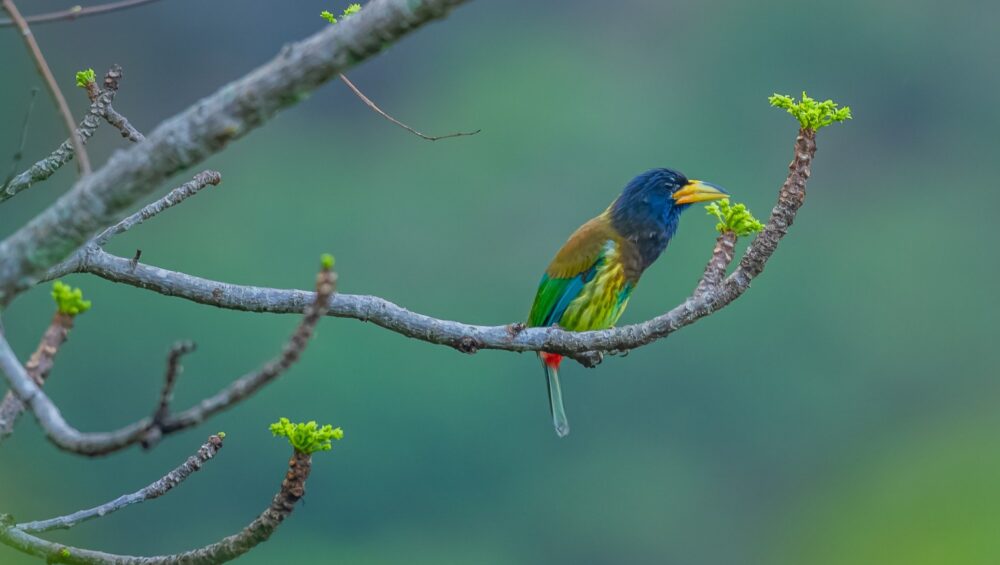
Bhutan has recorded more than 700 bird species, making it one of the most rewarding birdwatching destinations in the Eastern Himalayas. Its forests, rivers, wetlands, and protected areas provide important habitats for resident birds as well as migratory species.
The country is also home to several rare and endangered animals, including:
- Bengal tigers
- Snow leopards
- Red pandas
- Golden langurs
- Himalayan black bears
- Takin, Bhutan’s national animal
- Musk deer
- Himalayan serow
Another important reason for Bhutan’s rich biodiversity is its commitment to environmental conservation.
More than half of the country’s land area is protected through national parks, wildlife sanctuaries, nature reserves, and biological corridors. These protected landscapes help maintain connections between different habitats and allow wildlife to move across the country.
For visitors, this means that a journey through Bhutan can be much more than a cultural holiday. It can also be an opportunity to experience some of the Eastern Himalayas’ most remarkable natural environments.
What Birds Can You See in Bhutan?
Bhutan is particularly well known among birdwatchers for its diversity of Himalayan and subtropical bird species.
Whether you are an experienced birder with a detailed checklist or someone who simply enjoys watching colourful birds in nature, there is plenty to discover.
Here are some of the remarkable birds you may encounter during a birdwatching trip to Bhutan.
1. Black-Necked Crane
The black-necked crane is perhaps Bhutan’s most famous migratory bird.
Every winter, these elegant birds travel from the Tibetan Plateau to spend the colder months in Bhutan’s high-altitude valleys.
The most important wintering destination is Phobjikha Valley in western Bhutan, where the cranes arrive around October and generally remain until February or March.
Watching them move across the valley, feeding in the wetlands or flying gracefully above the surrounding hills, is one of Bhutan’s most memorable wildlife experiences.
The birds are particularly special to the local communities of Phobjikha, where they are respected and protected.
Every year, the Black-Necked Crane Festival is celebrated at Gangtey to welcome the returning birds and raise awareness about their conservation.
If seeing these magnificent cranes is on your Bhutan travel wish list, November to February is generally the best period to visit.
2. Himalayan Monal
“One of the most beautiful birds found in Bhutan’s mountain forests, the Himalayan monal is famous for its spectacular colours.”
The male has an iridescent plumage that reflects shades of green, blue, purple, and copper, making it particularly striking when sunlight falls across its feathers.
These birds are generally found in high-altitude forests and alpine areas.
Birdwatchers may look for the Himalayan monal around Chele La Pass near Paro and other suitable high-elevation forest habitats.
Seeing one in the wild can be a real highlight of a birdwatching journey.
3. Satyr Tragopan
The satyr tragopan is another fascinating Himalayan bird that attracts serious birdwatchers to Bhutan.
The male has a striking combination of red, orange, and spotted plumage, while the female is much more subtly coloured.
It usually inhabits dense temperate forests with thick undergrowth, making it a challenging bird to spot.
Areas around Bumthang, Sengor, and other forested parts of central and eastern Bhutan are worth exploring for this species.
Early mornings are often the most rewarding time for birdwatching in these habitats.
4. Rufous-Necked Hornbill
The rufous-necked hornbill is one of the most impressive birds found in Bhutan’s subtropical forests.
Its large size, distinctive curved bill, and unusual appearance make it an exciting species for bird enthusiasts.
It is associated with mature forest habitats in the country’s southern and central regions.
The forests around Zhemgang and Tingtibi are among the areas worth exploring for hornbills and other subtropical bird species.
Seeing a hornbill flying above the forest canopy is an experience that many birdwatchers remember long after their journey.
5. White-Bellied Heron
The white-bellied heron is one of the rarest and most endangered bird species in the world.
Bhutan is one of the few countries where this remarkable bird continues to survive.
It is associated with clean, undisturbed river habitats, particularly along larger river systems in Bhutan.
Spotting one is never guaranteed, even for experienced birdwatchers. However, its presence highlights the importance of Bhutan’s river ecosystems and conservation efforts.
For serious birdwatchers, the possibility of encountering such a rare species makes Bhutan especially interesting.
6. Beautiful Nuthatch
The beautiful nuthatch is another sought-after bird among specialist birdwatchers visiting Bhutan.
As its name suggests, it is an attractive forest bird, with distinctive plumage and a relatively large appearance for a nuthatch.
It inhabits broadleaf forests, particularly in the country’s central and eastern regions.
The forests around Zhemgang and Tingtibi are important birdwatching areas where visitors may search for this and other interesting Himalayan species.
7. Ward’s Trogon
Ward’s trogon is a beautiful and relatively elusive bird found in the Eastern Himalayas.
Its colourful appearance and association with forest habitats make it an exciting species for birdwatchers.
Bhutan’s eastern forests, including areas around Yongkola and Lingmethang, are particularly interesting for those hoping to encounter this species.
It is one of the reasons specialist birdwatchers often include eastern Bhutan in their itineraries.
What Wildlife Animals Can You See in Bhutan?
Birds are not the only reason to explore Bhutan’s natural landscapes.
The country’s forests and protected areas support an extraordinary variety of mammals, including some species that are difficult to find elsewhere.
Although wildlife sightings are never guaranteed, traveling through the right habitats with an experienced local guide can provide opportunities to encounter some remarkable animals.
1. Red Panda
The red panda is one of Bhutan’s most fascinating and elusive mammals.
With its reddish-brown fur, bushy striped tail, and distinctive facial markings, it is easily one of the most charming animals found in the Eastern Himalayas.
Red pandas generally inhabit cool temperate forests with bamboo undergrowth, particularly in areas with mature trees and suitable vegetation.
They are associated with protected forest habitats in Bhutan, including regions within Jigme Dorji National Park and other northern and central forest landscapes.
Because they are shy and spend much of their time in trees, spotting one requires patience and a little luck.
For wildlife enthusiasts, however, even the possibility of seeing a red panda makes exploring Bhutan’s forests exciting.
2. Golden Langur
The golden langur is one of Bhutan’s most distinctive primates.
Recognisable by its beautiful golden-orange fur and dark face, this rare monkey is particularly associated with the forests of south-central Bhutan.
Zhemgang and surrounding forest areas are important habitats for this species.
Unlike some other wildlife encounters that require long periods of searching, golden langurs can occasionally be spotted moving through the trees or near forest edges.
Their presence is another reason why Zhemgang is an interesting destination for nature and wildlife enthusiasts.
3. Takin – Bhutan’s National Animal
No wildlife discussion about Bhutan would be complete without mentioning the takin.
The takin is Bhutan’s national animal and is one of the country’s most unusual mammals.
It has a distinctive appearance, with a large body, thick coat, and unusual facial structure that makes it look like a combination of several different animals.
Takin are found in the Himalayan region and inhabit forested mountain slopes and alpine environments.
One of the easiest places to learn about and see takin in Bhutan is the Motithang Takin Preserve in Thimphu.
For visitors who do not have time to explore remote mountain habitats, this is a convenient opportunity to see Bhutan’s national animal.
4. Bengal Tiger
Bhutan is also home to the majestic Bengal tiger.
Unlike many destinations where tigers are mainly associated with lowland forests, Bhutan’s protected landscapes include habitats at different elevations.
Tigers are found in several protected areas, including Royal Manas National Park and other forested regions.
Bhutan’s biological corridors are particularly important because they allow animals to move between different habitats.
However, tigers are naturally elusive and difficult to observe in the wild.
A visit to Bhutan should not be planned around a guaranteed tiger sighting. Instead, travelers can appreciate the country’s remarkable conservation landscapes and the possibility of encountering wildlife along the way.
5. Snow Leopard
The snow leopard is one of the most elusive animals in the Himalayas.
Living in high-altitude mountain environments, it is perfectly adapted to rocky landscapes, cold temperatures, and steep terrain.
In Bhutan, snow leopards inhabit remote northern mountain regions, particularly within high-altitude protected areas.
They are extremely difficult to spot because of their excellent camouflage and naturally secretive behaviour.
For most visitors, seeing a snow leopard in the wild is unlikely. Nevertheless, knowing that these magnificent predators inhabit Bhutan’s mountains adds another dimension to the country’s incredible biodiversity.
6. Himalayan Black Bear
The Himalayan black bear is another fascinating mammal found in Bhutan’s forested landscapes.
Recognisable by its dark coat and characteristic chest marking, it inhabits a variety of forest environments.
Although these bears are part of Bhutan’s natural ecosystem, they are wild animals and should always be observed from a safe distance.
Visitors exploring forest trails should follow their guide’s instructions and avoid approaching or feeding wildlife.
7. Musk Deer
Bhutan’s high-altitude forests are also home to musk deer.
These shy mammals are generally found in mountain forests and areas with dense vegetation.
They are rarely seen because they are naturally cautious and tend to avoid human activity.
Their presence, however, contributes to the ecological importance of Bhutan’s forest ecosystems.
Best Places for Wildlife Watching and Birdwatching in Bhutan
One of the best things about exploring Bhutan is that each region offers a different natural environment.
If wildlife and birdwatching are important parts of your travel plans, choosing the right destinations can make a significant difference.
Here are some of the best places to consider.
1. Phobjikha Valley – Best for Black-Necked Cranes
Phobjikha Valley is one of Bhutan’s most beautiful natural destinations and a must-visit for anyone interested in birdwatching.
Located in western Bhutan, this wide glacial valley is famous for its wetlands, open landscapes, and wintering black-necked cranes.
During the winter months, visitors can watch the cranes feeding in the valley and flying between their roosting areas and nearby agricultural fields.
The Black-Necked Crane Information Centre is also worth visiting. It provides information about the birds, their migration, and the conservation efforts that help protect their habitat.
Beyond birdwatching, Phobjikha offers peaceful nature walks, beautiful mountain scenery, and opportunities to experience traditional village life.
2. Zhemgang – Best for Subtropical Wildlife and Birdlife
Zhemgang is one of Bhutan’s most interesting destinations for wildlife and nature enthusiasts.
Located in south-central Bhutan, the region is surrounded by rich forests and important protected areas.
Its subtropical environment supports a remarkable variety of birds and mammals.
Birdwatchers may look for hornbills, trogons, beautiful nuthatches, and other forest species, while wildlife enthusiasts may be interested in the golden langur and other mammals found in the region.
Zhemgang is also an important gateway for exploring the natural landscapes connected to Royal Manas National Park and Jigme Singye Wangchuck National Park.
For travelers interested in exploring a less-visited side of Bhutan, Zhemgang offers a very different experience from the popular western destinations.
3. Royal Manas National Park – Best for Lowland Wildlife
Royal Manas National Park is one of Bhutan’s most important wildlife conservation areas.
Located in southern Bhutan, it protects extensive subtropical forests, river systems, and grassland habitats.
The park supports an impressive variety of wildlife, including elephants, Bengal tigers, golden langurs, gaur, and numerous bird species.
Its warm climate and rich vegetation create a completely different environment from Bhutan’s high-altitude valleys.
For visitors interested in exploring Bhutan beyond monasteries and mountain scenery, the Royal Manas region offers an opportunity to experience the country’s subtropical wilderness.
Wildlife viewing depends on the season, access conditions, and the animals’ natural movements, so patience is important.
4. Chele La Pass – Best for Himalayan Mountain Birds
Located between Paro and Haa, Chele La is one of Bhutan’s highest motorable mountain passes.
The area is surrounded by forests and offers beautiful views of the Himalayan landscape.
For birdwatchers, the high-altitude forests around Chele La can be particularly rewarding.
Species such as Himalayan monal, pheasants, and other mountain birds may be encountered in suitable habitats.
The changing seasons also make this area interesting for nature photography.
Spring brings flowering rhododendrons, while autumn offers clear mountain views.
5. Bumdeling Wildlife Sanctuary – Best for Wintering Cranes
Located in eastern Bhutan, Bumdeling Wildlife Sanctuary is another important destination for black-necked cranes.
Like Phobjikha, it provides wintering habitat for these remarkable migratory birds.
The sanctuary also protects a variety of forest and wetland ecosystems that support different bird species and wildlife.
Because it is located in eastern Bhutan, visiting Bumdeling can be particularly rewarding for travelers planning a longer journey across the country.
It offers a chance to explore a quieter and less frequently visited part of Bhutan.
6. Bumthang – Best for Forest Birds and Mountain Landscapes
Bumthang is famous for its beautiful valleys, ancient monasteries, traditional villages, and peaceful countryside.
However, it is also an interesting destination for nature lovers.
The region’s forests and surrounding mountain landscapes support a variety of bird species, including pheasants and other Himalayan forest birds.
During winter, parts of the Bumthang region also provide habitat for black-necked cranes.
For travelers who enjoy combining culture, nature, and birdwatching, Bumthang is an excellent addition to a Bhutan itinerary.
When Is the Best Time for Wildlife Watching and Birdwatching in Bhutan?
Bhutan can be explored throughout the year, but the best time depends on the wildlife or bird species you hope to encounter.
Different seasons offer different opportunities.
Spring (March to May)
Spring is one of the best seasons for birdwatching in Bhutan.
As the weather becomes warmer, forests become active with bird calls, flowers begin to bloom, and many resident birds enter their breeding season.
This is an excellent time to explore forest habitats around Paro, Chele La, Bumthang, and eastern Bhutan.
Spring is also ideal for combining birdwatching with photography and nature walks.
Summer (June to August)
Summer is Bhutan’s monsoon season.
Although rainfall can make travel and forest walks more challenging, the countryside becomes exceptionally green.
Rivers flow strongly, forests become lush, and the natural environment feels particularly alive.
This season may appeal to travelers who enjoy quiet landscapes and are comfortable with some flexibility in their travel plans.
However, weather conditions should be considered when planning wildlife excursions.
Autumn (September to November)
Autumn is one of the most popular seasons for traveling in Bhutan.
The weather is generally pleasant, mountain views are often clear, and conditions are suitable for exploring different regions.
It is also an interesting time for birdwatching, as migratory birds begin moving through the country.
Towards the end of October and into November, black-necked cranes start returning to their wintering grounds.
If you want to combine birdwatching with Bhutan’s famous festivals and beautiful mountain scenery, autumn is an excellent choice.
Winter (December to February)
Winter is the best time to visit Phobjikha Valley if seeing black-necked cranes is your priority.
The birds spend the colder months in Bhutan before returning to their breeding grounds further north.
Winter is also a good time for exploring some of Bhutan’s lower-elevation forest habitats, depending on local weather and access.
Although temperatures can be cold in the mornings and evenings, sunny days often provide beautiful conditions for sightseeing and photography.
Is Bhutan Good for Wildlife Photography?
Absolutely. Bhutan offers extraordinary opportunities for nature photography, from colourful Himalayan birds to dramatic mountain landscapes and rare wildlife.
For bird photographers, the country’s different forest habitats provide opportunities to photograph pheasants, hornbills, trogons, cranes, and many other species.
Phobjikha Valley is particularly beautiful for photographing black-necked cranes against a backdrop of open wetlands and surrounding mountains.
Chele La and Bumthang offer opportunities for mountain and forest photography, while Zhemgang and southern Bhutan provide a completely different environment for capturing subtropical wildlife.
However, wildlife photography in Bhutan requires patience.
Animals are not always visible, and some of the rarest species live in remote habitats.
A good wildlife photography itinerary should therefore allow sufficient time in each location rather than rushing from one destination to another.
Tips for Planning a Wildlife and Birdwatching Trip to Bhutan
If you are planning a Bhutan wildlife tour or a dedicated birdwatching holiday, a little preparation can make your experience much more rewarding.
Here are a few practical tips.
1. Travel with a knowledgeable local guide
An experienced guide can help identify bird species, understand local habitats, and find suitable places for wildlife observation.
For serious birdwatching, a specialist birding guide is particularly valuable.
2. Carry binoculars
A good pair of binoculars can make a considerable difference when observing birds in forests, wetlands, and mountain landscapes.
3. Bring a camera with a suitable zoom lens
Wildlife photography often requires photographing animals from a distance. A telephoto lens can help you capture birds and mammals without disturbing them.
4. Start early in the morning
Many birds are more active during the early hours of the day.
Early morning excursions can provide excellent opportunities for birdwatching and wildlife observation.
5. Allow enough time in each destination
Wildlife encounters cannot be scheduled like visits to monuments.
Spending two or more nights in important birdwatching areas can provide better opportunities than simply passing through.
6. Respect wildlife and natural habitats
Avoid feeding animals, disturbing nesting areas, making unnecessary noise, or approaching wildlife too closely.
Responsible wildlife watching helps protect the very species that make Bhutan so special.
7. Keep your itinerary flexible
Weather, road conditions, and wildlife activity can change.
A flexible itinerary allows your guide to adjust plans and make the most of suitable opportunities.
Can You Include Wildlife and Birdwatching in a Regular Bhutan Tour?
Yes. You do not necessarily need to plan a dedicated wildlife expedition to experience Bhutan’s natural beauty.
Many wildlife and birdwatching opportunities can be included in a regular Bhutan holiday.
For example, travelers visiting Paro can explore the forested areas around Chele La. Those traveling towards Punakha and Phobjikha can include time for crane watching and nature walks.
A longer itinerary through central and eastern Bhutan can introduce visitors to the forests of Bumthang, Zhemgang, and other biodiversity-rich regions.
The best approach depends on your interests.
If you are a serious birdwatcher hoping to photograph specific species, your itinerary should be designed around bird habitats and seasonal movements.
If you simply enjoy nature, a combination of cultural sightseeing, scenic drives, village walks, and wildlife observation may be perfect.
This is one of the advantages of traveling with a Bhutan-based tour operator. Your journey can be planned around the experiences you genuinely enjoy.
Final Thoughts: Discover Bhutan Beyond Its Famous Landmarks
Bhutan is a destination where nature remains an important part of everyday life.
From the wintering black-necked cranes of Phobjikha to the colourful Himalayan monal, the elusive red panda, and the remarkable wildlife of southern Bhutan, the country offers an extraordinary variety of natural experiences.
What makes Bhutan particularly special is not simply the number of species found here. It is the opportunity to explore different ecosystems within one journey, from subtropical forests and peaceful wetlands to high-altitude mountain landscapes.
For some travelers, the highlight may be watching cranes flying across Phobjikha Valley on a cold winter morning. For others, it may be hearing hornbills calling from a forest canopy or spotting a golden langur moving through the trees.
And sometimes, the most memorable wildlife experiences are the unexpected ones.
At Maebar Travel, we believe that discovering Bhutan should be about experiencing the country beyond its famous attractions. Whether you are interested in birdwatching, wildlife photography, nature walks, or simply exploring Bhutan’s beautiful natural landscapes, we can help create a journey that reflects your interests.
If you are planning a Bhutan wildlife and birdwatching holiday, let our local team help you discover the best regions, seasons, and experiences for your trip.
Explore Bhutan with Maebar Travel and discover a different side of the Kingdom of Happiness.